The Art Nouveau Coupola <BR> of the Galeries Layette - © Galerie des Galeries

Architectural Modernity and Artistic Continuity

For 112 years, the dome of Galeries Lafayette—erected in 1912—has drawn the gaze of visitors to the flagship store on Boulevard Haussmann. With its two facets—interior and exterior, structure and decor—it embodies the dynamic interplay between tradition and modernity that lies at the heart of the department store’s enduring legacy.

In 1893, two cousins from Alsace, Théophile Bader and Alphonse Kahn, joined forces to take over the lease of a modest haberdashery and, in 1894, opened the first “Aux Galeries Lafayette” store at 1 Rue Lafayette. The brand’s rapid success enabled the founders to significantly expand the initial sales area of 70 square meters, and the “stone strategy”—a proactive real estate policy—guided the company’s investments during its early years.

In 1902, Galeries Lafayette—which had been incorporated as a public limited company in 1899—purchased 38, 40, and 42 Boulevard Haussmann. The buildings were gradually converted for commercial use to establish a “second wing” on Boulevard Haussmann, and in 1903, Alphonse Kahn referred for the first time to “our department stores” to describe the complex comprising the two buildings on Boulevard Haussmann and Rue Lafayette.

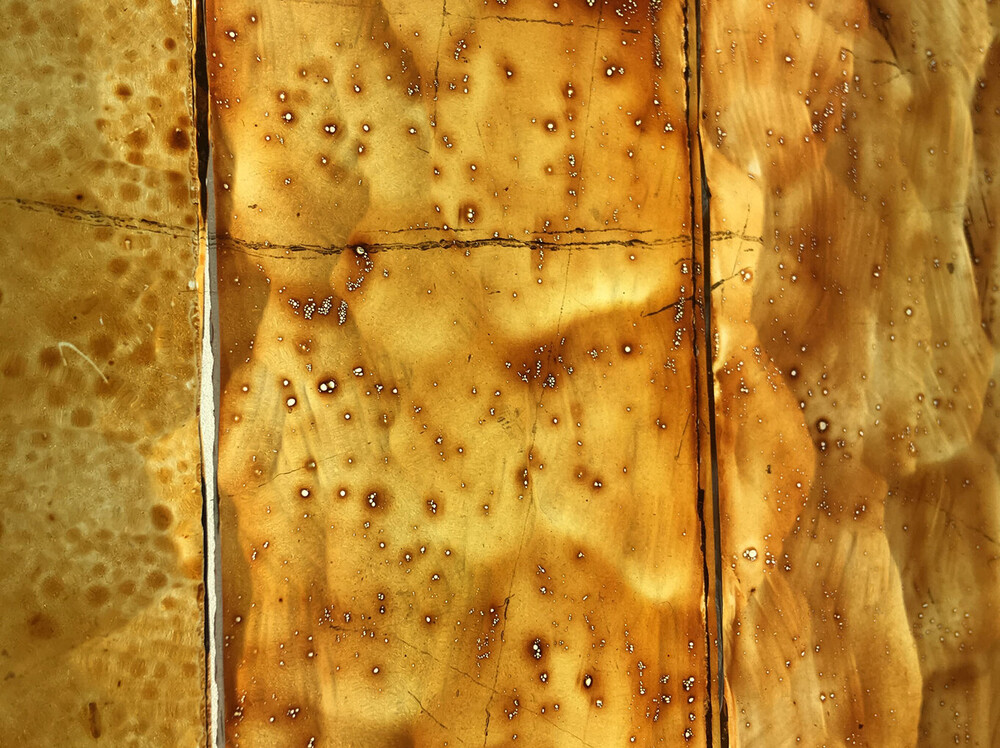
It was during the expansions undertaken from 1909 to 1912 that the dome was erected. Leading artists of the Art Nouveau movement were commissioned by architect Ferdinand Chanut. Jacques Gruber, a master glassmaker from the École de Nancy, created the colorful, Neo-Byzantine-inspired stained-glass windows that adorn the dome; Louis Majorelle crafted the ironwork for the balconies and the grand staircase in the main hall; and Édouard Schenck created the ironwork for the dome.

Ferdinand Chanut’s design responded to the request of his client, Théophile Bader, who wished to create a “luxury bazaar” and turn the sales area into a theatrical space. The merchandise—abundant and luxurious—was to be displayed in a sumptuous setting, bathed in warm, golden light filtered through the dome’s stained-glass windows.

The Art Nouveau Coupola <BR> of the Galeries Layette - © Galerie des Galeries

Il s’agit d’un chantier d’envergure, et il faut noter que la vente continue dans la partie du magasin déjà inaugurée en 1908. La modernité des matériaux utilisés répond à l’ambition de ce chantier. La coupole est en effet une structure de métal, dont l’usage s’est progressivement banalisé dans l’architecture des grands magasins au cours de la seconde moitié du XIXème siècle.

Elle prend appui sur dix piliers de béton disposés en plan circulaire, à une époque où l’usage de ce matériau suscite encore des réticences. Déjà en 1908, les Galeries Lafayette sont le premier bâtiment à usage de commerce construit en béton armé. Les propriétés de ce matériau permettent la transformation d’un traditionnel immeuble de rapport haussmannien en grand magasin devant supporter le poids des aménagements, des marchandises et des nombreux clients. Ces techniques de construction modernes et innovantes, et notamment l’architecture métallique modulaire, permettent de réaliser en quelques mois le chantier de construction de la coupole qui intervient à la fin des travaux.

Ces éléments s’appuient sur un anneau métallique, une structure de type Eiffel à la base de la construction et fournie par l’entreprise Savey. Cette entreprise, également à l’origine de la verrière du Grand Palais ou de la gare d’Orsay, inscrit les Galeries Lafayette dans cette architecture métallique parisienne caractéristique de la période. La coupole, qui culmine à 43 mètres de hauteur, est coiffée d’une lanterne métallique, contenant aujourd’hui une poulie qui permet de hisser le fameux sapin de Noël et divers supports publicitaires.

Crédits photos : (c) Archives Galeries Lafayette, (c) Caroline Richard

The Art Nouveau Coupola <BR> of the Galeries Layette - © Galerie des Galeries

The Stained-Glass Windows of Jacques Grüber

Trained at the Écoles des Beaux-Arts in Nancy and Paris, Jacques Grüber was, alongside Émile Gallé and Louis Majorelle, one of the founders of the École de Nancy, a pillar of the Art Nouveau movement in the Lorraine region. He devoted himself entirely to the art of stained glass after 1900.

When the founders of Galeries Lafayette and architect Ferdinand Chanut commissioned Jacques Grüber to decorate the dome, he had a studio in Paris on Rue d’Alésia, and his practice was flourishing.

In accordance with the plan devised by Théophile Bader and Ferdinand Chanut, Jacques Grüber went on to create a series of colorful stained-glass windows in a style often described as “Neo-Byzantine.”

Louis Majorelle’s Metalwork

The balusters on the lower floors, adorned with clematis foliage, were created by Louis Majorelle, who extended this theme to the banister of the monumental staircase that once adorned the building’s grand hall. An ode to nature—vibrant, colorful, ephemeral, and ever-changing—the Galeries Lafayette department store places floral motifs at the center of its architecture and decor.

Louis Majorelle (1859–1926) was a French cabinetmaker and designer, a leading figure of the Art Nouveau movement. Based in Nancy, he is known for his furniture featuring sinuous lines and floral motifs inspired by nature. His work, both aesthetic and artisanal, exemplifies the rise of the École de Nancy movement, combining innovation and tradition in furniture design. His Art Nouveau style blended seamlessly with the department store’s refined aesthetic.

The Art Nouveau Coupola <BR> of the Galeries Layette - © Galerie des Galeries

GALERIE DES GALERIES prend en charge de nombreux navigateurs
mais il semble que celui-ci soit obsolète,
veuillez utiliser le navigateur Google Chrome ou bien mettre à jour votre navigateur.

GALERIE DES GALERIES supports many browsers
but it seems that it is obsolete,
please use the Google Chrome browser or update your browser.